
Kimchi jjigae is the stew Koreans make when there’s a jar of sour kimchi in the fridge. It’s spicy, tangy, and deeply savory, and it’s almost always served with a bowl of rice.
We eat it a lot at home. Honestly, there’s no secret technique. Two things make the biggest difference: well-fermented, sour kimchi and its juice. This guide shows how I make easy kimchi jjigae with pork, plus a simple trick for getting a richer, more familiar flavor.
Quick answer:
- What it is: a Korean stew of sour kimchi, pork, and often tofu in a spicy broth
- Taste: sour, spicy, and savory, with tender pork
- Spice level: about 2 out of 3, adjustable from 1 to 3
- The key: sour kimchi plus a splash of kimchi juice
- Time: about 50 minutes, including a quick homemade broth
What Is Kimchi Jjigae?
In Korean, it’s 김치찌개 (“KIM-chee JJEE-geh”). Jjigae means stew. The main ingredient is kimchi (김치), Korea’s fermented napa cabbage seasoned with chili and garlic. If kimchi is new to you, start with our Kimchi 101 guide.
As the stew simmers, the kimchi turns soft and silky. Its sour, spicy flavor melts into the broth, and the pork adds richness. The broth turns red-orange, tangy, and a little rich from the pork fat.
It’s a main dish for lunch or dinner, any day of the week.
Why Sour Kimchi Matters
Kimchi keeps fermenting in the fridge. Over a few weeks, it gets more sour and softer. That older, sour kimchi is exactly what you want for kimchi jjigae. Fresh kimchi tastes flat and a little raw in a stew, while sour kimchi gives the broth its deep, tangy flavor.
Ripe kimchi smells clearly sour, and the cabbage looks a bit translucent. A sour smell is normal. Throw it out only if you see fuzzy mold or it smells rotten instead of sour.
Don’t pour out the liquid in the jar, either. Kimchi juice is full of flavor, and a little of it makes the stew taste rounder and more complete.
If your kimchi is still fresh, leave it out at room temperature to ferment faster. How long depends on the season. In warm summer weather, about 2 days can be enough. When it’s cool, it can take up to a week. Smell and taste it each day, and move it to the fridge once it’s pleasantly sour. In a pinch, add a teaspoon of rice vinegar to the stew instead. It adds tang, but the flavor won’t be as deep.
Kimchi Jjigae With Store-Bought Kimchi: My Mixing Trick
Store-bought kimchi works great for kimchi jjigae, and any brand is fine. For convenience, I buy kimchi that’s already cut into bite-size pieces. In Korean markets, it’s often labeled mak-kimchi (막김치) or mat-kimchi (맛김치). Whole-leaf kimchi, called pogi-kimchi (포기김치), works too, but you’ll have to cut it yourself.
At home, I use sour kimchi I made myself. Because we make kimchi jjigae so often, I also keep a jar of store-bought kimchi just for stew. My mix is about two-thirds homemade and one-third store-bought. Here’s how each choice tastes:
| Kimchi you use | How the stew tastes |
|---|---|
| Homemade only | A little light |
| Two-thirds homemade, one-third store-bought | Balanced, a flavor almost everyone likes |
| Store-bought only | Bold, with strong savory depth (umami) |
Every family makes kimchi a little differently, so homemade kimchi tastes different from house to house. A little store-bought kimchi brings the stew closer to the kimchi jjigae most people know.
Most store-bought kimchi is already a bit sour, so you can usually use it right away. If yours still tastes fresh, see the souring tips above.

Is Kimchi Jjigae Spicy?
Yes, usually. On this blog’s 0 to 3 scale, it’s about a 2. The heat comes from the kimchi itself and from gochugaru (고춧가루), Korean chili flakes. How hot it gets depends a lot on your kimchi.
- 1 (mild): skip the gochugaru, use less kimchi juice, and add more tofu
- 2 (medium): the recipe as written
- 3 (hot): add more gochugaru or a sliced hot green chili
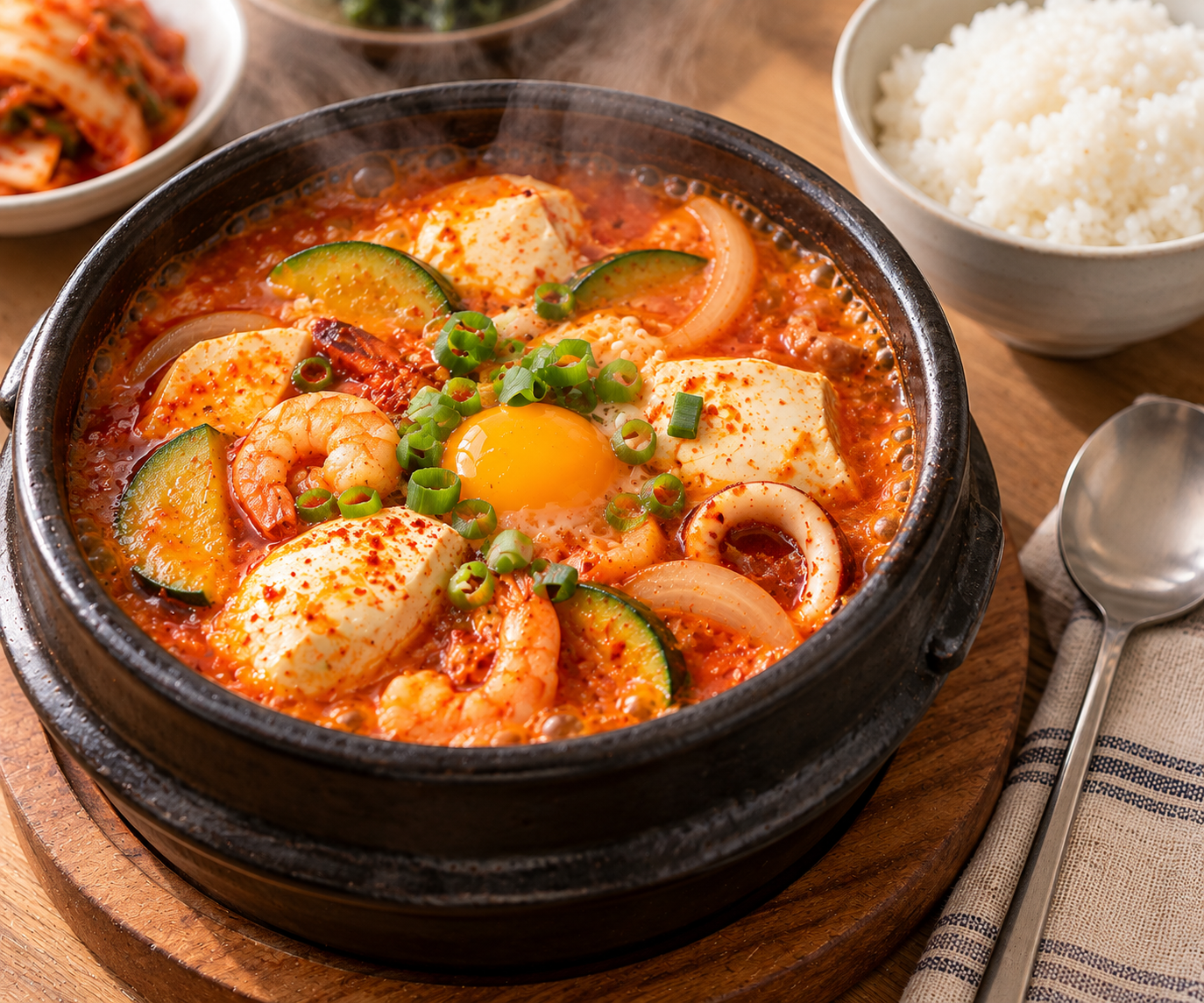
Plain rice helps a lot. For a no-chili stew, try sundubu jjigae without the chili, or check our Korean Spice Guide.
How Koreans Eat Kimchi Jjigae
Kimchi jjigae comes to the table bubbling hot, often right in the pot. Each person gets a bowl of white rice, and everyone shares the stew and a few small side dishes called banchan (반찬). Take a spoonful of rice, then a spoonful of stew.
It often tastes even better the next day, so many families make a big pot. Leftover kimchi jjigae is a favorite next-day lunch.
Kimchi Jjigae Ingredients and Where to Buy Them
Look for napa cabbage kimchi at a Korean market, like H Mart. Many regular supermarkets also carry it in the refrigerated section, often near the tofu. Pre-cut kimchi saves you a step. For pork, I use pork shoulder or pork ribs. Shoulder stays tender and cooks quickly. Ribs take a little longer, but the meat near the bone adds a lot of flavor. Korean markets sell both already cut into small pieces for stew.
Dried anchovies and kelp for the broth are in the dried goods aisle at Korean markets. You’ll find gochugaru there too. Tofu, onion, garlic, and green onions are at any grocery store. When I add tofu, I use firm or extra-firm.
| If you can’t find | Use | What changes |
|---|---|---|
| Sour kimchi | Fresh kimchi plus 1 tsp rice vinegar | Tangy, but lighter and less deep |
| Gochugaru | See our gochugaru swaps | Heat and color vary |
| Dried anchovies | Dashi powder, or kelp and dried shiitake | Less fishy, still savory |
Easy Kimchi Jjigae: How I Make It
My method is simple. I make a quick anchovy and kelp broth. Then everything goes into the pot together: pork, kimchi, kimchi juice, garlic, and gochugaru. It all simmers with the lid on until the kimchi is soft. Tofu goes in near the end, when I’m using it.
- No need to fry first: just simmer everything in the broth with the lid on. The kimchi turns tender, and the flavor stays clean.
- Shake off the extra seasoning: whole-leaf kimchi has chili paste and shredded radish packed between the leaves. Shake off the loose bits before chopping, so the broth isn’t gritty.
- Ribs need more time: if you use pork ribs, simmer about 15 minutes longer, until the meat is tender and pulls away from the bone.
- Season last: kimchi varies a lot in salt and spice, so taste before adding soy sauce or salt.
Amounts, times, and signs of doneness are in the recipe card below.

Easy Kimchi Jjigae With Pork (Korean Kimchi Stew)
Ingredients
Equipment
Method
- Make the broth. Put the water, anchovies, and kelp in a pot. Bring to a boil over high heat, then lower to medium and boil 10 minutes. Strain. You should have about 2¾ cups (650 ml).
- Prep. Shake the loose filling off the kimchi and chop it into bite-size pieces. Cut the pork into bite-size pieces. Slice the onion, green onion, and tofu.
- Put everything in the pot. Add the pork, kimchi, kimchi juice, garlic, gochugaru, mirin, pepper, and broth to the pot. Cover with the lid.

- Simmer with the lid on. Bring to a boil over high heat. Lower to medium-low and cook 10 minutes, then lower to low and cook 10 minutes more. The kimchi should be soft and slightly translucent, and the pork cooked through with no pink.
- Add tofu and season. Add the tofu, if using, and the onion. Taste, then season with soup soy sauce and a pinch of salt as needed. Simmer 2 minutes.
- Finish. Add the green onion, bring back to a boil, and serve hot with rice.
Notes
- Spice level: About 2 out of 3. For milder (1), skip the gochugaru, use half the kimchi juice, and add tofu. For hotter (3), add more gochugaru or a sliced hot green chili.
- Kimchi: Sour, well-fermented kimchi is the key. Most store-bought kimchi is already a little sour. If yours is fresh, leave it at room temperature until it tastes pleasantly sour (about 2 days in summer, up to a week when it’s cool), then refrigerate. Or add 1 teaspoon rice vinegar to the stew.
- Homemade vs. store-bought: Homemade kimchi alone makes a lighter stew. Store-bought alone tastes bolder. A mix of about 2/3 homemade and 1/3 store-bought is balanced.
- Too sour? Add a small pinch of sugar.
- Pork ribs: Simmer about 15 minutes longer in step 4, until the meat is tender and pulls away from the bone.
- Tuna or Spam: Use instead of pork and add in the last 5 minutes.
- Vegan option: Use vegan kimchi, a kelp and dried shiitake broth, and extra tofu and mushrooms instead of pork.
- Storage: Refrigerate within 2 hours and eat within 3 to 4 days. Reheat until boiling.
If Something Goes Wrong
| Problem | Fix |
|---|---|
| Too sour | Add a small pinch of sugar and simmer a few more minutes. |
| Tastes flat | Your kimchi may be too fresh. Add more kimchi juice, or a little soup soy sauce. |
| Too spicy | Add more tofu or a splash of broth, and eat it with plenty of rice. |
| Too salty | Add a little water or broth, and skip the soy sauce. |
Vegan Kimchi Jjigae, Storage, and Safety
No. It’s usually made with pork and anchovy broth, and most kimchi contains fish sauce or salted shrimp.
For a vegan version, buy kimchi labeled vegan and check the ingredients for fish, anchovy, or shrimp. Make the broth with kelp and dried shiitake mushrooms. Skip the pork and add extra tofu and mushrooms.
Cool leftovers and refrigerate them within 2 hours. Eat them within 3 to 4 days, and reheat in a pot until boiling. You can freeze it for 2 to 3 months, but tofu turns spongy, so freeze it without tofu if you can.
Allergens: fish and often shellfish (in kimchi and anchovy broth), soy (tofu, soy sauce), and wheat (in most soy sauce).
Food safety: cook pork until no pink remains.
Kimchi Jjigae FAQ
Can I use store-bought kimchi for kimchi jjigae?
Yes. Store-bought kimchi alone makes a bold, savory stew. Pre-cut kimchi is the easiest to use.
Should I fry the kimchi first?
Many recipes fry the pork and kimchi in oil before adding broth, which makes the stew a bit richer and oilier. I don’t. Simmering everything together with the lid on is simpler, and the kimchi still turns soft and tender.
Can I make kimchi jjigae with fresh kimchi?
You can, but it won’t taste as deep. Leave it out to sour first, or add a teaspoon of rice vinegar.
Can I use tuna or Spam instead of pork?
Yes. Canned tuna and Spam are both popular in Korea. Add them in the last 5 minutes, since they’re already cooked.
Do I have to add tofu?
No. I add it only sometimes. It makes the stew milder and more filling.
That jar of sour kimchi in your fridge is exactly what easy kimchi jjigae is for. Grab some pork, make a quick broth, and don’t forget the kimchi juice. If you’re still left with extra sour kimchi, make kimchi fried rice next.



Leave a Reply