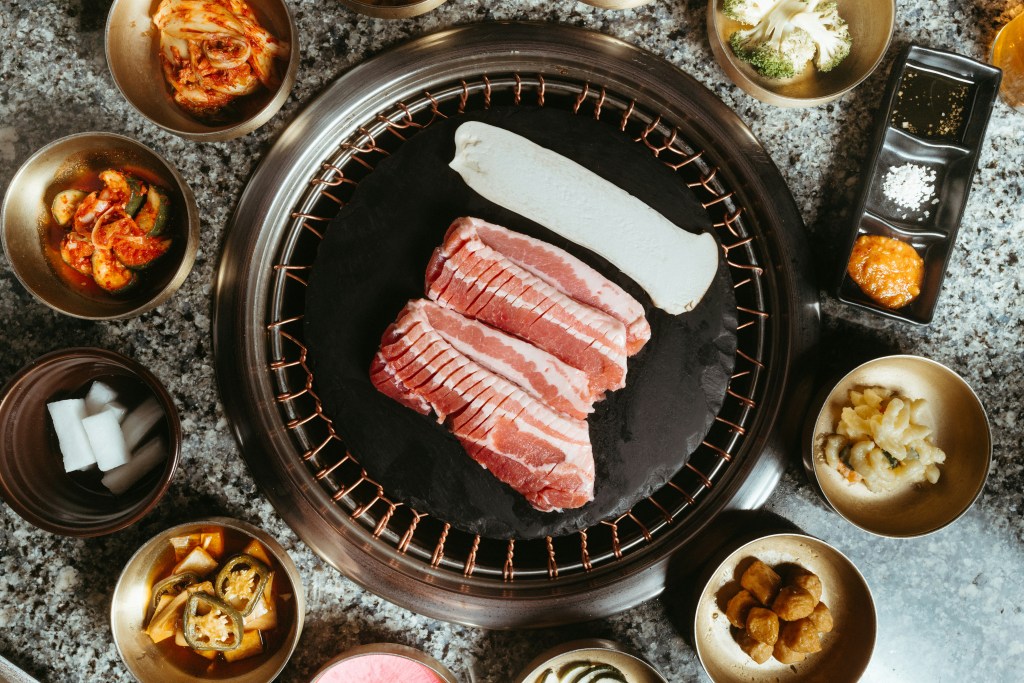
Grilling the meat is the easy part of Korean BBQ. The part that confuses most first-timers comes after: a basket of lettuce, a few small dishes of sauce, and no instructions. That’s where ssam comes in.
This Korean BBQ ssam guide shows you how to build a lettuce wrap, which sauces to use, and which fillings go well together. You’ll also find a simple way to set it up at home, even if you only shop at a regular supermarket.
What Is Korean BBQ Ssam?
At a Korean BBQ restaurant, raw or marinated meat is cooked on a grill in the middle of the table. The most popular choice is samgyeopsal (삼겹살, “sahm-gyup-sahl”), thick slices of fresh pork belly. Sweet soy-marinated meats like bulgogi (불고기, thin-sliced beef) and galbi (갈비, short ribs) are also common.
Ssam (쌈, “sahm”) means “wrap.” You take a piece of grilled meat, put it on a leaf, add a little sauce and a few extras, and fold it into one small bundle. Everyone makes their own wraps as they go, so no two bites are exactly the same.
The usual wrappers are soft red-leaf or green-leaf lettuce and perilla leaves, called kkaennip (깻잎, “ggen-nip”). Perilla has a bold herbal flavor, a bit like mint mixed with anise. Some restaurants also offer paper-thin pickled radish slices (ssam-mu, 쌈무) as a sweet-and-sour wrapper.
Why wrap at all? Plain pork belly is rich and fatty. Cold, crisp lettuce and a salty sauce balance it, so the meal feels less heavy.
How to Eat Korean BBQ Ssam in One Bite
The one rule to remember: make the wrap small, and eat it whole in one bite.
A ssam is meant to be tasted all at once. The meat, sauce, garlic, and cool lettuce should hit together. It also falls apart if you bite it in half. The sauce drips and the meat slides out onto your plate.
So if a wrap looks too big for your mouth, don’t try to take two bites. Build a smaller one next time. A good target is about the size of a golf ball once it’s folded. Start with a leaf about the size of your palm, and tear bigger leaves in half.
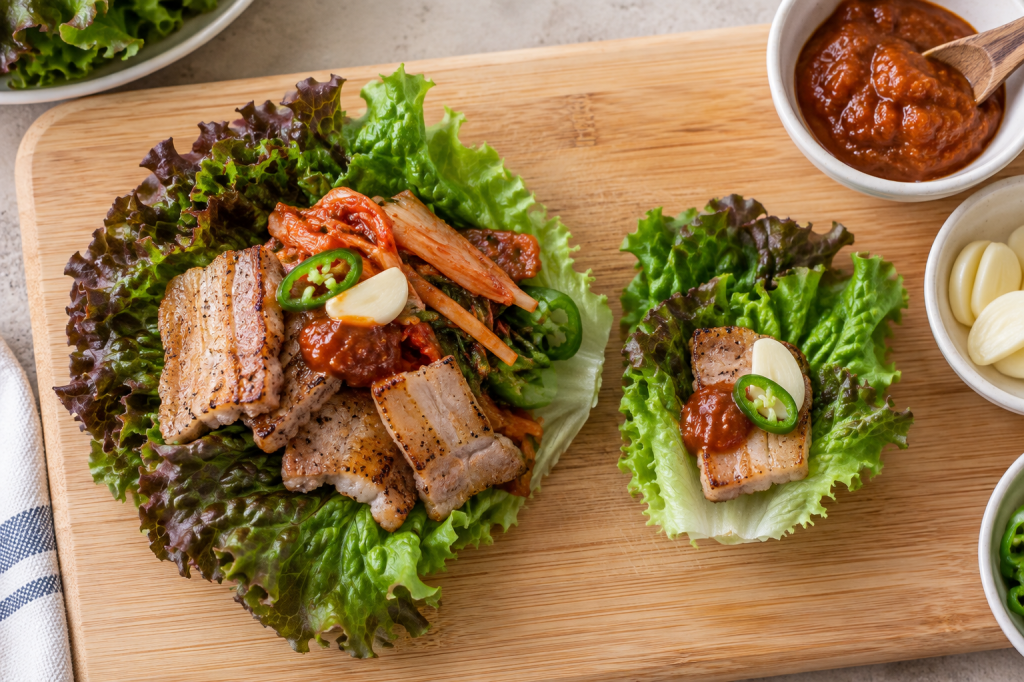
Here’s how to build one:
- Lay a lettuce leaf flat in your open palm. Add a perilla leaf on top if you like.
- Place one bite-sized piece of meat in the center. One piece is enough.
- Add about half a teaspoon of sauce.
- Top with one or two small extras, such as a slice of garlic or a ring of green chili.
- Fold the sides of the leaf up and over the filling to close it.
- Put the whole wrap in your mouth at once.
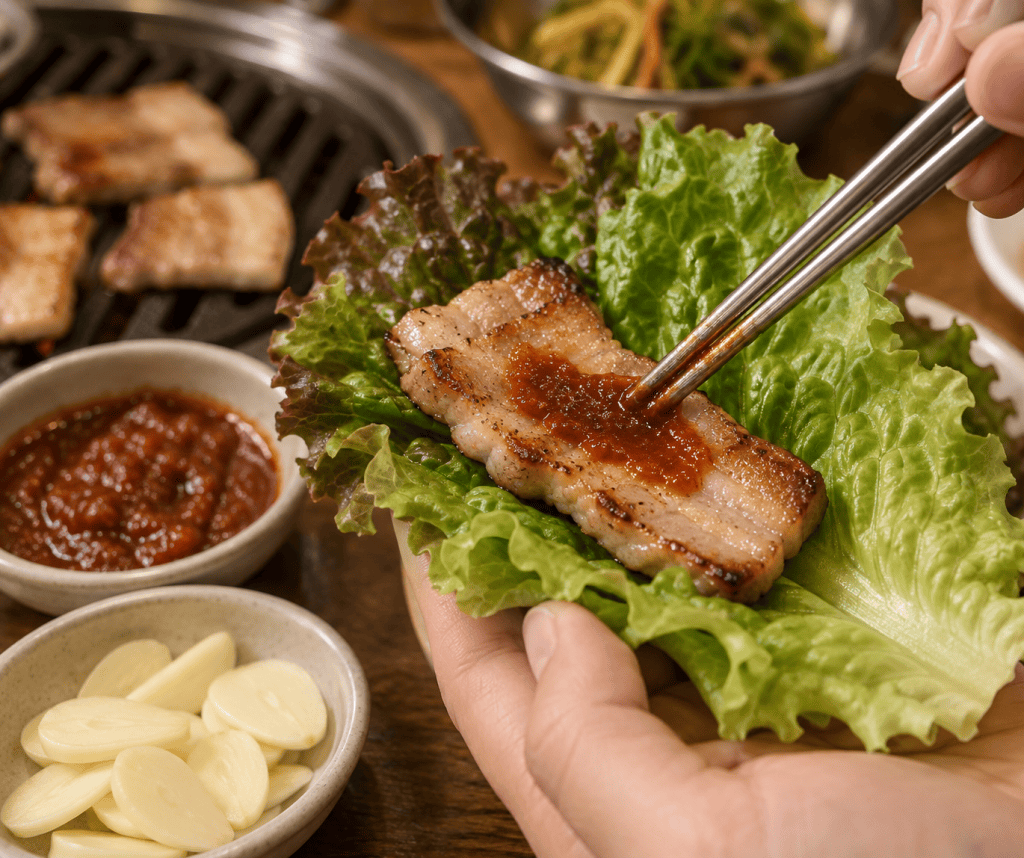
You don’t need to wrap every piece of meat. Koreans often switch between a wrap, a piece dipped in sauce, and a spoonful of stew or rice.
Ssamjang, Gochujang, and Other Korean BBQ Sauces
Most Korean BBQ tables have at least two sauces. Here’s what they are and how they differ.
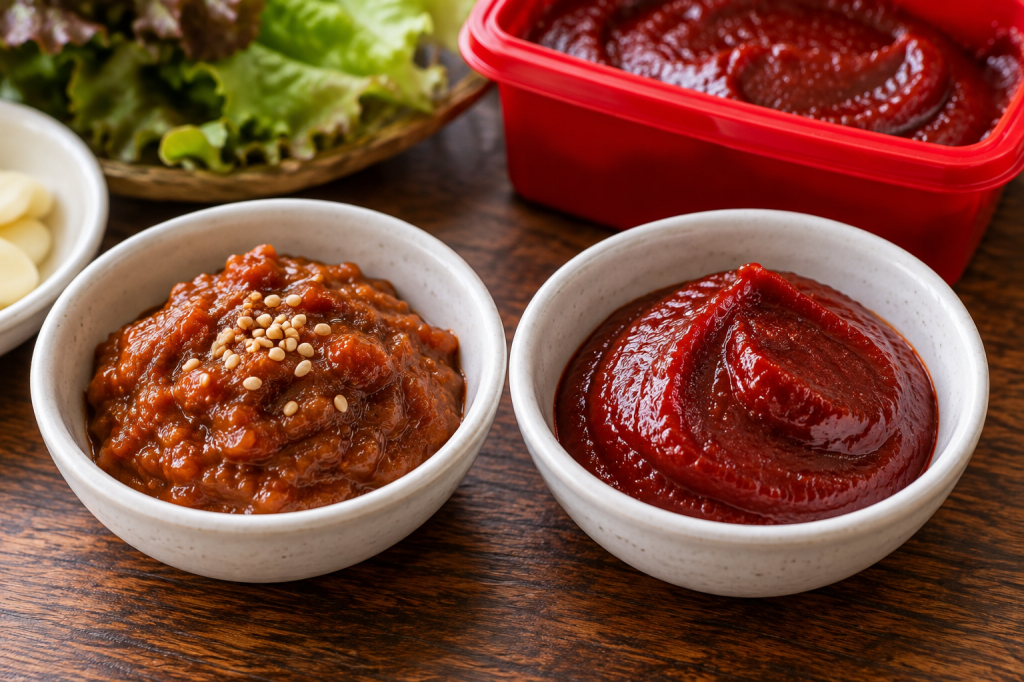
Ssamjang (쌈장, “SAHM-jahng”) is the classic wrap sauce. It’s a thick paste made from doenjang (된장, fermented soybean paste, similar to a chunky, earthy miso) and gochujang (고추장, sweet and spicy red chili paste). Garlic and sesame are often mixed in. It tastes salty, savory, and just a little spicy.
Plain gochujang is my personal favorite for ssam. It’s not the classic choice, but I actually prefer a store-bought tub from the market over ssamjang. Gochujang on its own is sweeter and spicier, without the salty, earthy soybean flavor that ssamjang has. If ssamjang tastes too salty or funky to you, give plain gochujang a try. It’s also easier to find, since many regular supermarkets now carry it in the international aisle. Use a little less than you would ssamjang, because it’s hotter.
Gireumjang (기름장, “gee-REUM-jahng”) is toasted sesame oil with salt and black pepper. It isn’t spicy at all. Dip a piece of plain pork belly or beef in it to taste the meat itself. To make it, mix 2 tablespoons (30 ml) of sesame oil with 1/4 teaspoon salt and a pinch of pepper.
Onion soy sauce shows up at some restaurants. It’s thin-sliced onion in soy sauce and vinegar. It’s tangy and fresh, and the onion slices are great inside a wrap.
A few places serve regional extras, like a warm, salty anchovy sauce on Jeju Island. These are fun to try, but they aren’t standard.
| Sauce | Taste | Spice (0–3) | Vegan? |
|---|---|---|---|
| Ssamjang | Salty, earthy, savory | 1 | Often, but check the label |
| Gochujang | Sweet, spicy | 2 | Usually, but check the label |
| Gireumjang | Nutty, salty | 0 | Yes |
| Onion soy sauce | Tangy, salty | 0 | Yes |
Is Korean BBQ Ssam Spicy?
The meat usually isn’t. Plain pork belly and bulgogi contain no chili. All the heat comes from what you add to the wrap, so you decide how spicy each bite gets.
The combination table below uses this simple scale:
- 0: no heat
- 1: mild, a gentle warmth
- 2: medium, noticeable but easy for most people
- 3: hot, for people who like real spice
Raw garlic isn’t chili-hot, but it has a sharp bite. If it’s too strong for you, grill the slices until soft and golden. They’ll turn sweet and mild.
Best Korean BBQ Ssam Combinations to Try
When I make ssam, I almost always add minari and perilla leaves. Minari (미나리, “mee-nah-ree”) is a Korean water herb with long, crunchy stems. It tastes fresh and green, somewhere between celery and parsley, with a light peppery edge. Paired with perilla, it adds a lot of herbal freshness to rich pork belly.
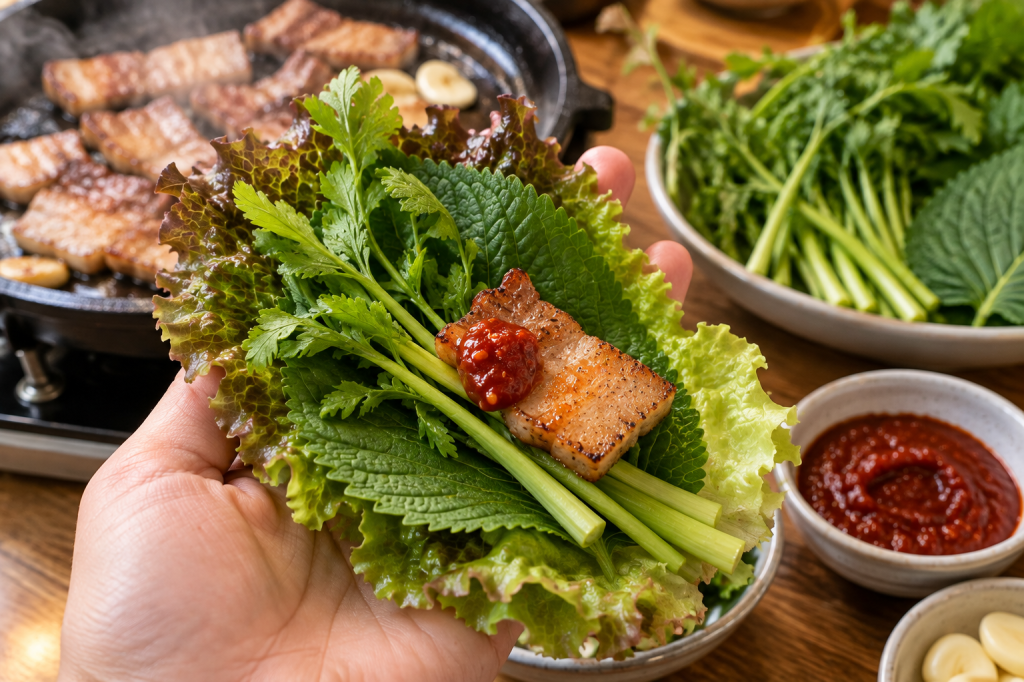
Here are more combinations to try. Mix and match freely.
| Combination | What goes in it | Spice | Why it works |
|---|---|---|---|
| The Classic | Lettuce, pork belly, ssamjang, garlic, green chili | 2 | Rich, salty, crunchy, and sharp in one bite |
| Herb Lover’s Wrap | Lettuce, perilla, minari, pork belly, gochujang | 2 | Fresh herbs cut through the fatty pork |
| Gentle Start | Lettuce, pork belly dipped in gireumjang, grilled garlic | 0 | Simple and mild; lets the meat shine |
| Grilled Kimchi Wrap | Lettuce, pork belly, kimchi grilled in pork fat | 1 | Soft, sour, slightly caramelized kimchi |
| Radish Wrap | Pickled radish slice, thin beef or bulgogi | 0 | Sweet-sour radish balances rich beef |
| Rice Wrap | Lettuce, a small spoon of rice, meat, ssamjang | 1 | More filling, like a mini meal |
| Onion Wrap | Lettuce, pork belly, onion from the soy dip | 0 | Crisp and tangy, keeps it light |
| Fire Wrap | Perilla, pork belly, gochujang, raw garlic, hot green chili | 3 | For spice fans only |
| Mushroom Wrap (vegan) | Lettuce, perilla, grilled king oyster mushroom, grilled garlic, vegan gochujang | 2 | Meaty texture with all the classic flavors |
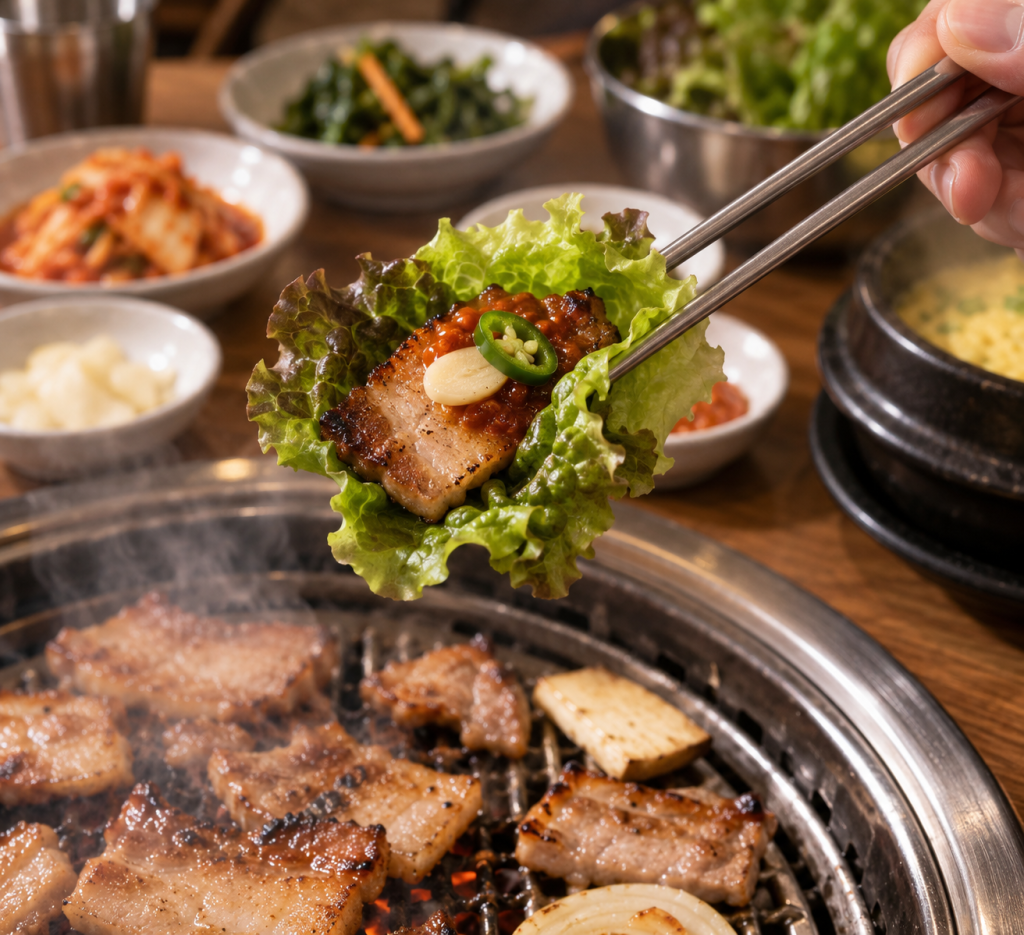
To invent your own, use this formula: one rich item (meat or mushroom), one sauce, and one or two fresh or sharp extras (herbs, garlic, chili, onion, or kimchi). If a wrap tastes flat, it usually needs more of the fresh part, not more sauce.
Eating Korean BBQ Ssam at a Restaurant
Korean BBQ is a shared meal. The table orders meat together, and one or two people usually handle the grilling with tongs and scissors. Small side dishes called banchan (반찬, “BAHN-chahn”) come with the meat, such as kimchi, a spicy scallion salad, and pickled vegetables. A soybean paste stew and rice often arrive near the end of the meal.
Ran out of lettuce? In Korea, many BBQ restaurants will bring more if you ask, and some have a self-serve vegetable bar. The phrase is “Sangchu deo juseyo” (상추 더 주세요, “sahng-choo duh joo-seh-yo”), which means “More lettuce, please.” Outside Korea, refill rules depend on the restaurant, so it’s fine to ask your server.
You may also see someone wrap a ssam and hand it to another person at the table. Koreans sometimes do this for a parent, partner, or close friend as a small gesture of care. If someone makes one for you, eat it in one bite.
How to Make Korean BBQ Ssam at Home
A heavy skillet or grill pan on the stove works fine for home Korean BBQ. This is a simplified version. It uses a stovetop instead of a charcoal grill, so you’ll lose the smoky flavor, and it skips most of the side dishes.
Prep time: 20 minutes
Cook time: 20 to 30 minutes, in batches
Total time: about 45 minutes
Servings: 4
Spice level: 0 to 3, chosen by each person at the table
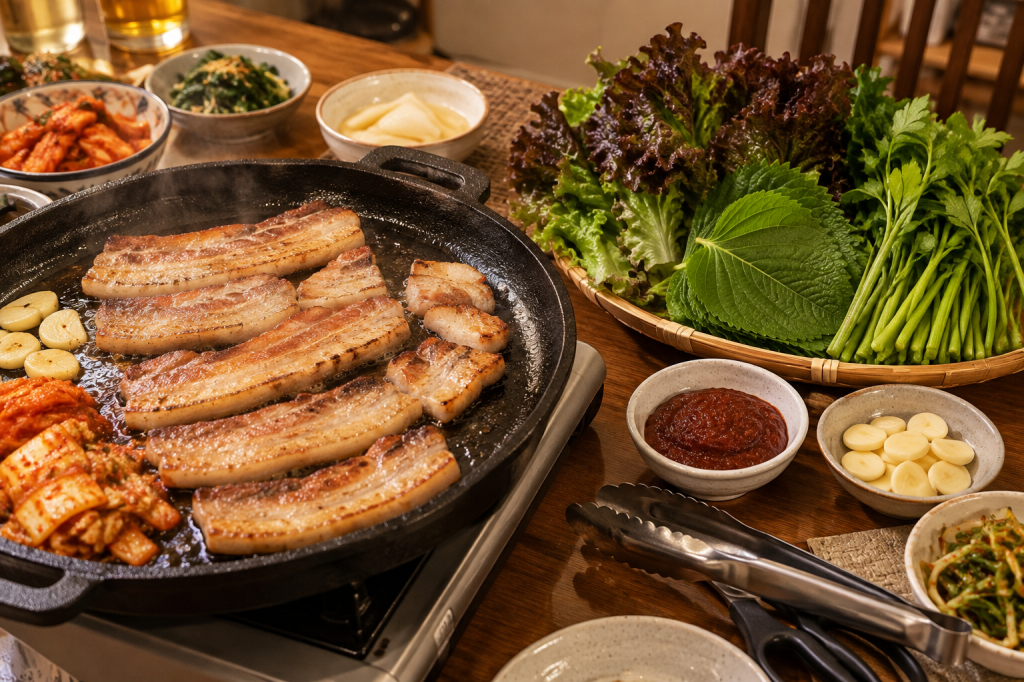
Essential ingredients:
- 2 lb (900 g) fresh, skinless pork belly, sliced 1/4 to 1/2 inch (6 to 12 mm) thick
- 2 heads red-leaf or green-leaf lettuce
- 6 to 8 cloves garlic, thinly sliced
- Store-bought gochujang or ssamjang, about 1/2 cup (120 g) for the table
Optional ingredients:
- 1 bunch perilla leaves (about 20 leaves)
- 1 bunch minari (about 7 oz / 200 g), roots trimmed, cut into 3-inch (7 cm) pieces
- 2 green chilies (jalapeño or serrano), thinly sliced
- 1 cup (about 150 g) napa cabbage kimchi, for grilling
- Gireumjang (see the sauce section above)
- Cooked short-grain rice
Quick homemade ssamjang (optional): Stir together 2 tablespoons (about 35 g) doenjang, 1 tablespoon (about 20 g) gochujang, 1 minced garlic clove, 1 tablespoon chopped scallion, 1 teaspoon sesame oil, and 1 teaspoon toasted sesame seeds. Add 1 teaspoon honey if you want it less salty.
Instructions
- Wash the greens. Rinse the lettuce and perilla leaves. Wash minari well under running water, since it grows in wet fields and can hold dirt near the base. Dry everything with a salad spinner or towel, because wet leaves make soggy wraps.
- Set the table. Put the greens, garlic, chilies, and sauces in small bowls so everyone can reach them.
- Heat the pan. Heat a large cast-iron skillet over medium-high heat for 2 to 3 minutes. A drop of water should sizzle away right away. You don’t need oil.
- Grill the pork belly. Lay the strips in one layer without crowding. Leave them alone for 3 to 4 minutes, until the bottom is deep golden and lifts easily. Flip once and brown the other side.
- Cut and finish. Use kitchen scissors to cut the strips into 1-inch (2.5 cm) pieces. Keep cooking until the cut edges are golden and crisp, with no pink in the center. Pork should reach at least 145°F (63°C).
- Grill the extras. Push the meat to one side. Cook the kimchi and some garlic slices in the pork fat for 2 to 3 minutes, until soft and lightly browned.
- Wrap and eat. Let everyone build their own wraps. Keep grilling in small batches so the meat stays hot.
Safety notes: Pork belly smokes and spatters, so turn on the range hood or open a window. Use separate tongs for raw meat. If you use a portable butane burner at the table, follow the maker’s instructions and keep the room ventilated. Never use a charcoal grill indoors, because it produces carbon monoxide.
Korean Market vs. Regular Supermarket: Two Ways to Shop
No Korean grocery store nearby? You can still make good ssam. The table below shows what to buy at each type of store, and how the flavor changes when you swap.
| Ingredient | At a Korean market | Regular supermarket only | How it changes the flavor |
|---|---|---|---|
| Pork belly | Pre-sliced for Korean BBQ | Ask the butcher for fresh, skinless pork belly, sliced thick | No change if it’s fresh. Don’t use bacon, which is cured and smoked. |
| Sauce | Ssamjang or gochujang | Gochujang (often in the international aisle) | Sweeter and spicier than ssamjang |
| Perilla leaves | Refrigerated produce | Shiso if available, or skip | Shiso is lighter and more citrusy |
| Minari | Refrigerated produce, often seasonal | Watercress | More peppery, less celery-like |
| Lettuce | Red- or green-leaf lettuce | Same, or butter lettuce | Almost no change |
| Pickled radish | Ssam-mu in the fridge section | Very thinly sliced quick-pickled daikon or radish | Close if sliced thin enough |
If you can’t find gochujang either, a white miso mixed with a little sriracha makes a usable wrap sauce. It will taste milder and less deep than Korean chili paste, so treat it as a backup.
Vegan and Vegetarian Korean BBQ Ssam
Korean BBQ is centered on meat, but the wrap itself is easy to make plant-based. Lettuce, herbs, garlic, chili, and most sauces contain no animal products.
For the grill, try thick slices of king oyster mushroom, pressed firm tofu, zucchini, eggplant, or onion. Brush them with a little oil and salt so they brown well.
Check labels on a few items. Most ssamjang and gochujang are made without animal products, but some brands add fish-based seasonings. Most kimchi contains fish sauce or salted shrimp, so look for one labeled vegan. At restaurants, vegetables usually share the grill with meat.
Korean BBQ Ssam Troubleshooting
My wraps keep falling apart. They’re too big. Use one piece of meat and tear large leaves in half.
Everything tastes too salty. Cut back on the sauce. Half a teaspoon per wrap is plenty. Adding more herbs also helps.
The pork belly isn’t crispy. The pan was too crowded or not hot enough, so the meat steamed. Cook fewer pieces and wait for a golden crust before flipping.
It’s burnt outside but raw inside. Lower the heat to medium and cut the pieces smaller once the outside browns.
The kitchen is full of smoke. Pour off some fat between batches and avoid maximum heat.
Leftovers, Storage, and Allergens
Refrigerate cooked meat within 2 hours and eat it within 3 to 4 days. Reheat it in a hot skillet to bring back the crisp edges. Leftover pork belly is great chopped into kimchi fried rice, or served over rice with leftover herbs and a spoonful of gochujang.
Keep opened gochujang and ssamjang in the fridge and follow the package date. Homemade ssamjang keeps for about a week in a sealed container in the fridge. Wash herbs and lettuce close to serving time, since they wilt fast.
Allergens: Ssamjang, doenjang, and gochujang usually contain soy and often wheat. Sesame appears in many sauces. Kimchi usually contains fish or shellfish.
Korean BBQ Ssam FAQ
Can I use bacon instead of pork belly?
You can, but it won’t taste the same. Bacon is cured and often smoked. Korean BBQ pork belly is fresh and unseasoned, and the sauces and greens add the flavor.
Is ssamjang the same as gochujang?
No. Gochujang is chili paste. Ssamjang is gochujang mixed with soybean paste, so it’s saltier, earthier, and less spicy.
What if I can’t find minari or perilla?
Lettuce alone works fine. For a similar fresh, herbal bite, try watercress or shiso. The flavor will be a little different.
Is it rude to take two bites of a wrap?
Nobody will be offended. It’s just messy, and you’ll miss the mix of flavors. Make the next wrap smaller.
The best Korean BBQ ssam is the one you build to your own taste. For me, that means minari, perilla, and a dab of plain gochujang. Start with the classic wrap, then try an herb-heavy one or a no-spice one, and see what you keep going back to. Just keep each wrap small enough to eat in one bite.



Leave a comment