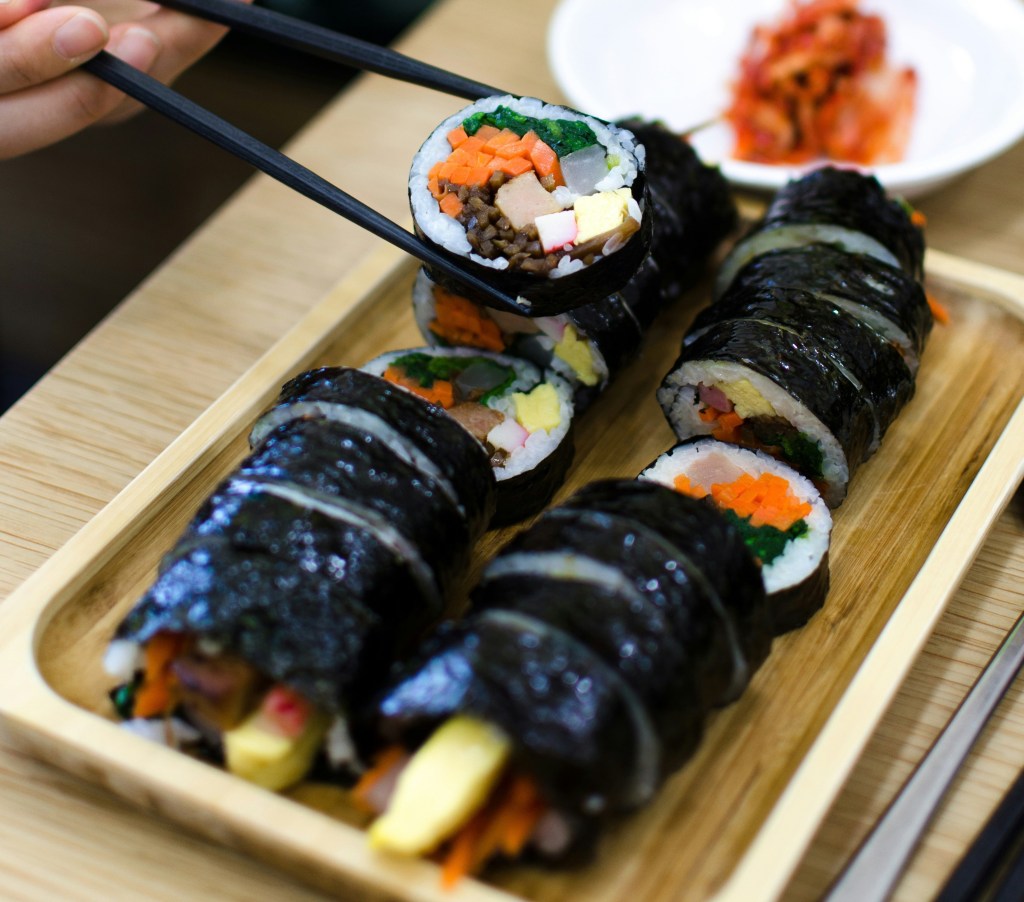
Kimbap looks like a sushi roll, but it tastes different. The rice is seasoned with sesame oil, not vinegar. The fillings are cooked or pickled, so each slice is crunchy, soft, sweet, and salty at the same time.
In this kimbap guide, you’ll learn what’s inside a classic roll and how to make one at home. You’ll also find out how to roll it so it doesn’t fall apart, and how to make it with brown rice or cauliflower rice.
What Is Kimbap?
Kimbap (김밥, “GEEM-bahp”) is a Korean rice roll. Gim means roasted seaweed, and bap means cooked rice. You’ll also see it spelled “gimbap.” It’s the same food.
Rice is spread on a sheet of seaweed, topped with a row of fillings, and rolled into a log. The log is then cut into 8 to 10 round slices.
Koreans eat kimbap for a quick lunch, a picnic, a school trip, or a snack on the go. It’s eaten at room temperature, with chopsticks or fingers. No dipping sauce is needed.
How is it different from sushi? Kimbap rice has sesame oil and salt instead of vinegar and sugar. Raw fish is not typical. And a kimbap roll is usually thicker, with more fillings inside.
Common Kimbap Fillings and How They Change the Taste
The rice and seaweed stay the same. The fillings are what make each roll different. A vegetable roll tastes light and nutty. Tuna with mayo is rich and creamy. Kimchi makes it tangy and a little spicy.
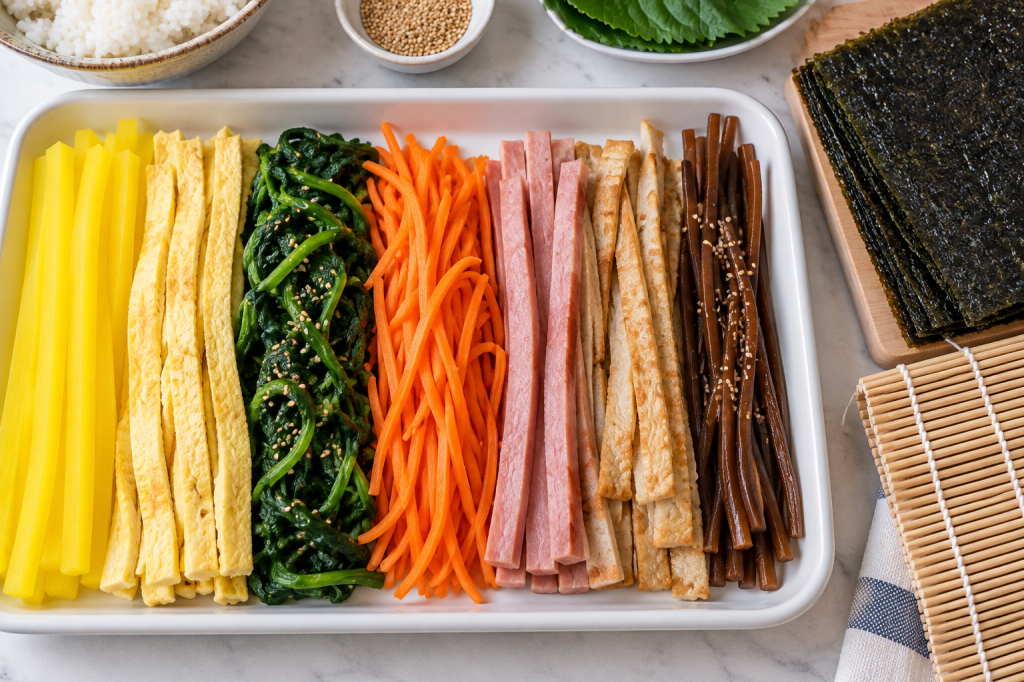
A classic roll from a Korean kimbap shop usually has these fillings:
| Filling | What it is | What it adds |
|---|---|---|
| Danmuji (단무지) | Yellow pickled radish | Crunch, sweet-sour flavor |
| Egg | Thin omelet cut into strips | Soft, mild bite |
| Spinach | Boiled and seasoned with sesame oil | Fresh flavor, green color |
| Carrot | Thin strips, lightly stir-fried | Sweetness, orange color |
| Ham or imitation crab | Long, thin strips | Salty, savory flavor |
| Eomuk (어묵) | Korean fish cake | Savory, slightly chewy |
| Ueong (우엉) | Burdock root cooked in soy sauce and sugar | Chewy bite, sweet-salty flavor |
You don’t need all seven. For a first roll, use yellow radish, egg, spinach, carrot, and one protein. Try to mix soft fillings with crunchy ones. The yellow radish matters most. Many Koreans say kimbap doesn’t taste right without it.
Is Kimbap Spicy?
Classic kimbap has no chili at all. On a 0 to 3 spice scale, it’s a 0. That makes it a safe first Korean food for people who don’t like heat.
Some versions are spicy. Kimchi kimbap is about a 1 or 2. Kimbap with chopped hot green chilies can be a 3. To add heat to a mild roll, dip each slice in a little gochujang (고추장), a sweet and spicy Korean chili paste.
Kimbap Shops in Korea: What to Order
Korea has a huge number of small kimbap restaurants, called gimbap-jip (김밥집). They’re cheap and fast. Many make each roll to order at the front counter. For takeout, the roll is sliced and wrapped in foil.
These shops also serve other simple dishes. One of the most popular orders is kimbap with a bowl of ramyeon (라면), Korean instant noodles. The hot, salty soup and the cool rice roll go well together.
If you visit Korea or a Korean neighborhood abroad, this list can help you read the menu:
| Menu name | What’s inside | Spice (0–3) |
|---|---|---|
| Yachae gimbap (야채김밥) | The basic roll. Despite the name (“vegetable”), it often has egg and ham. | 0 |
| Chamchi gimbap (참치김밥) | Tuna with mayo, often with perilla leaves | 0 |
| Chijeu gimbap (치즈김밥) | Basic roll plus cheese | 0 |
| Sogogi gimbap (소고기김밥) | Seasoned beef | 0 |
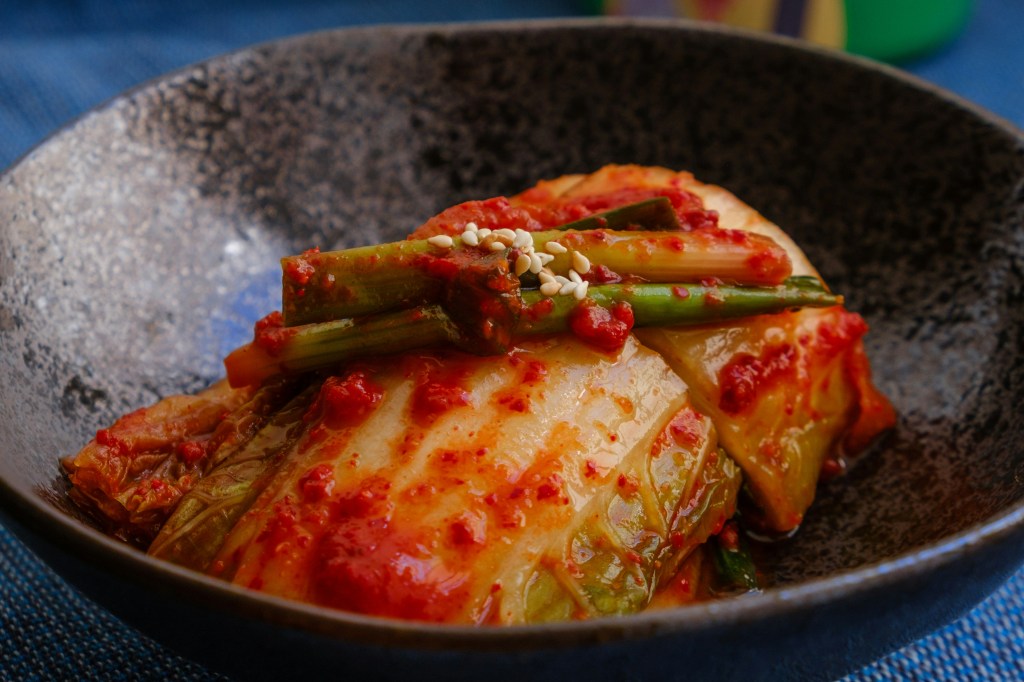
| Gimchi gimbap (김치김밥) | Stir-fried kimchi | 1–2 |
| Ttaengcho gimbap (땡초김밥) | Chopped hot green chilies | 3 |
| Kkoma gimbap (꼬마김밥) | Small rolls with a mustard dipping sauce | 0 |
One more thing you might see at home: the two end pieces of a roll are messy, with fillings sticking out. Koreans call them kkodari (꼬다리). They usually don’t make it to the plate. The person rolling the kimbap eats them.
My Favorite Way to Eat Kimbap: On a Mountain
I always take kimbap when I go hiking. I eat it when I reach the top. It doesn’t need heating, it’s easy to carry, and after a long climb it tastes great.
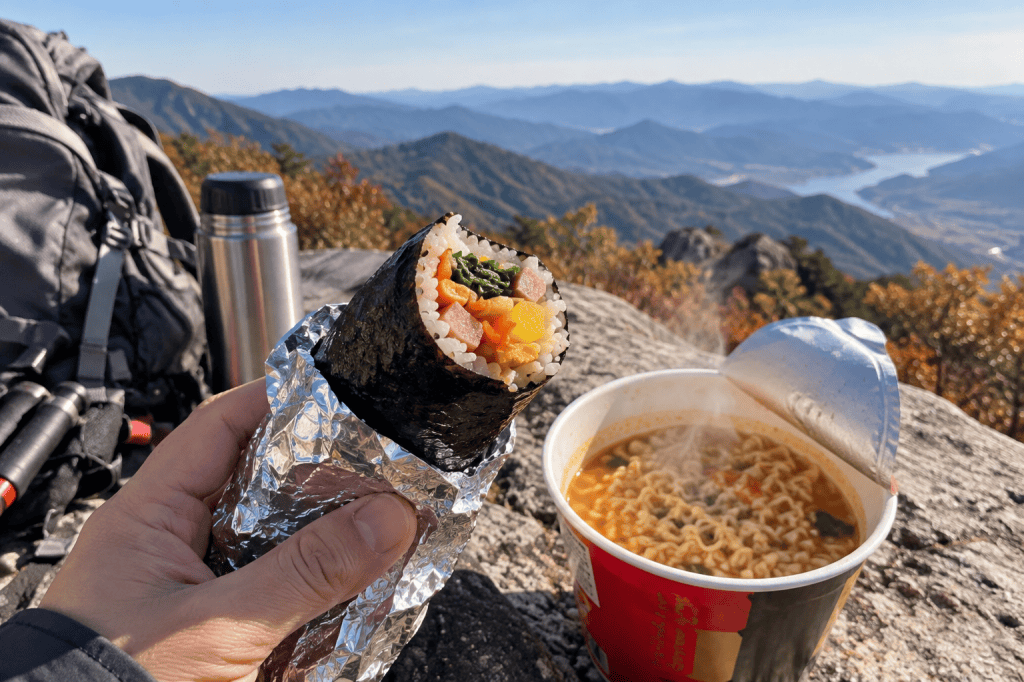
Some hikers don’t even slice the roll. They wrap the whole log in foil. At the top, they peel the foil back bit by bit and bite into it like a burrito. No knife, no box, and no chopsticks. The rice stays soft because it isn’t cut open, and nothing falls apart in your bag.
A cup of instant noodles makes it even better. Bring hot water in a thermos, pour it in, and wait a few minutes. Hot soup and cool kimbap on a chilly summit is a hard combination to beat.
Tips for the trail:
- Make the kimbap the morning of your hike.
- Keep it out of the sun, and eat it within a few hours.
- Carry out all trash, including leftover noodle soup.
- Check your park’s rules about hot food and stoves.
New to Kimbap? Try a Roll From a Korean Market First
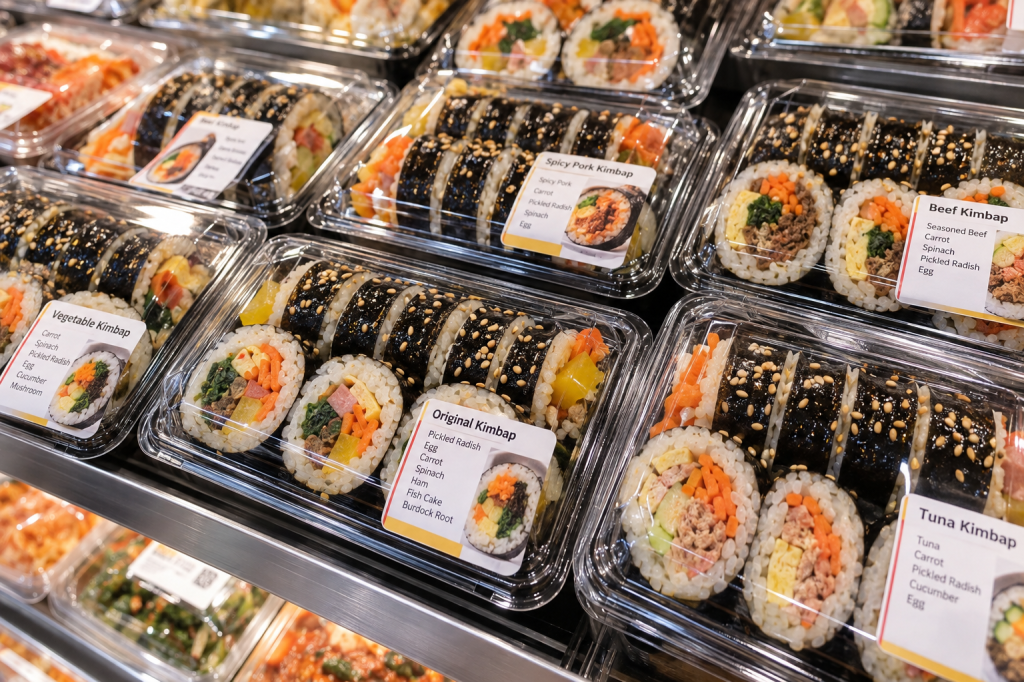
You can make kimbap at home, and the recipe below shows you how. But if you’ve never eaten it, buy a roll first. Many Korean grocery stores sell fresh kimbap made that day, often in the deli or ready-to-eat section.
Tasting a store-bought roll helps a lot. You’ll learn how the rice should feel, how salty it should be, and how the fillings taste together. Then you’ll know what you’re aiming for when you make your own.
Buy it on the day it’s made and eat it the same day, at room temperature. Putting it in the fridge makes the rice hard.
Sesame allergy warning: Store-bought kimbap almost always contains sesame. The rice is usually mixed with sesame oil, and the outside is brushed with more oil and sprinkled with sesame seeds. Even a plain vegetable roll has it. If you or someone you’re feeding is allergic to sesame, read the label carefully or ask the staff before buying. Fresh rolls from a deli counter may not have a full ingredient label, so asking is the safest choice. Egg, wheat, soy, and fish are also common in store-bought rolls.
Frozen Kimbap vs. Homemade: How Do They Taste?
Korean markets and some large U.S. stores also sell frozen kimbap. Many of these rolls are vegetarian, with tofu and vegetables. You heat them in the microwave.
Frozen kimbap is handy to keep in the freezer. But fresh kimbap tastes quite different:
| Frozen | Homemade | |
|---|---|---|
| Served | Warm, from the microwave | At room temperature |
| Rice | Soft, then chewy as it cools | Tender and fluffy |
| Seaweed | Soft and damp | Firmer, with a toasty smell |
| Vegetables | Soft | Crisp |
| Time | A few minutes | About an hour |
The biggest difference is the smell of sesame oil and seaweed, and the crunch of the radish. Freezing softens both. If you liked the frozen kind, the fresh one is worth trying.
Easy Kimbap Recipe
Prep time: 40 minutes
Cook time: 20 minutes
Total time: 1 hour (plus time to cook the rice)
Makes: 4 rolls (2 to 4 servings)
Spice level: 0
You’ll need
- 4 sheets roasted seaweed for kimbap, or sushi nori (about 7.5 × 8 in / 19 × 21 cm)
- 4 cups (about 740 g) cooked short-grain rice, still warm
- 1 tablespoon (15 ml) toasted sesame oil, plus a little for brushing
- ½ teaspoon salt
- 4 strips yellow pickled radish (danmuji)
- 3 large eggs and a pinch of salt
- 1 medium carrot (about 4 oz / 120 g), cut into thin strips
- 1 bunch spinach (about 8 oz / 225 g), plus ¼ teaspoon salt and 1 teaspoon sesame oil
- 1 to 2 tablespoons cooking oil
Optional: 4 strips ham, imitation crab, or fish cake; 4 strips cooked burdock root; toasted sesame seeds.
Tools: a bamboo rolling mat and a sharp knife. Plastic wrap or a clean kitchen towel also works in place of a mat.
Where to buy: A Korean or Asian grocery store has everything, including kimbap seaweed and “kimbap sets” with radish and burdock already cut to size. A regular supermarket has sushi nori, short-grain “sushi rice,” eggs, vegetables, imitation crab, and sesame oil. You can also order yellow radish and rolling mats online. Don’t use small seasoned seaweed snacks. They’re too small and too oily.
Substitutions:
- No yellow radish? Use cucumber strips. The roll will taste fresher and less sweet than the classic.
- No kimbap ham? Use thick deli ham or Spam, or leave it out.
- No short-grain rice? Medium-grain rice like Calrose works. Jasmine and basmati aren’t sticky enough.
How to Make Kimbap Step by Step
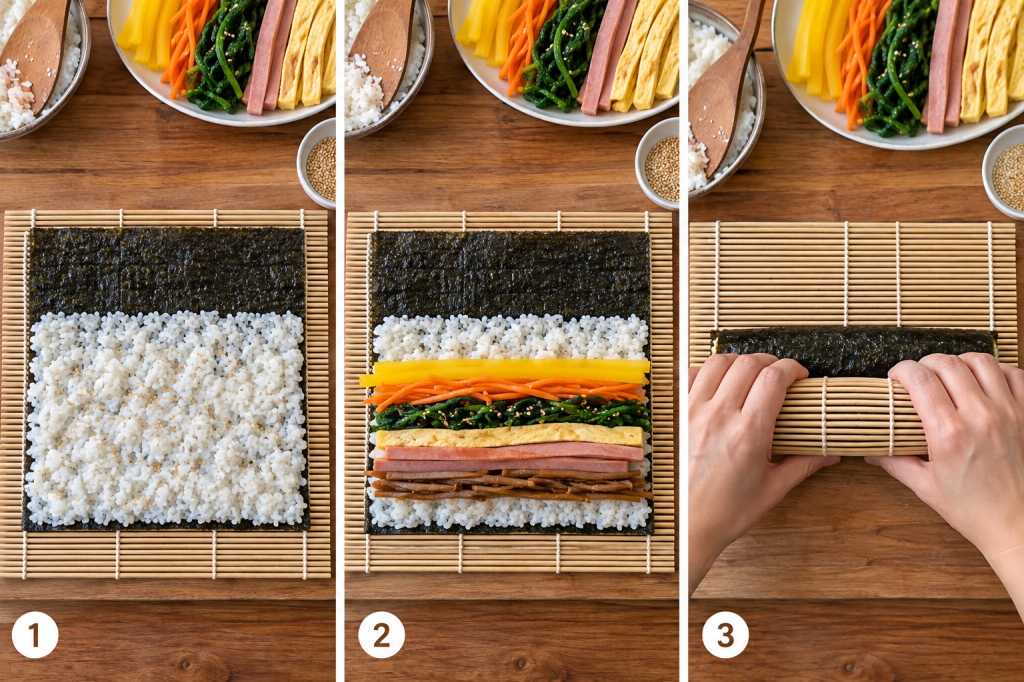
- Season the rice. Mix the warm rice with the sesame oil and salt. Fold gently so you don’t mash it. Taste it. It should be lightly salty. Let it cool until warm, not steaming.
- Cook the spinach. Boil it for 20 to 30 seconds, until it wilts and turns bright green. Rinse in cold water. Squeeze hard until no water drips out. Mix with the salt and sesame oil.
- Cook the carrot. Stir-fry with a little oil and a pinch of salt for 1 to 2 minutes. It’s ready when it bends easily but is still bright orange.
- Make the egg. Beat the eggs with salt. Cook them in a thin layer in an oiled pan over low heat. Flip when the top is no longer wet. Don’t let it brown. Cool, then cut into long strips.
- Prepare the rest. Pan-fry the ham or fish cake for 1 to 2 minutes, until the edges turn light gold. Pat the radish dry with a paper towel.
- Spread the rice. Put a seaweed sheet on the mat, shiny side down. With damp fingertips, spread about 1 cup (185 g) of rice in a thin, even layer. Cover the bottom two-thirds of the sheet. Leave about 1¼ inches (3 cm) bare at the top.
- Add the fillings. Lay them side by side in a tight row, about a third of the way up from the bottom. Don’t stack them high.
- Roll. Lift the mat and fold it over the fillings. Tuck the seaweed edge firmly under the fillings and squeeze. Then keep rolling forward, pressing lightly. The bare strip seals the roll.
- Rest. Place the roll seam side down for 5 minutes. Brush the top with a little sesame oil.
- Slice. Wipe your knife with a damp towel. Cut ½-inch (1.5 cm) slices with gentle sawing strokes. Wipe the blade every few cuts.
Why Does My Kimbap Fall Apart?
This happens to almost everyone at first. Here are the usual causes.
It burst when I cut it. There was too much rice or too much filling. Use a thin rice layer and a sharp knife. Let the blade do the work instead of pushing down.
The seaweed tore while rolling. The rice was too hot, or a filling was wet. Cool the rice first and squeeze the spinach well.
The roll is loose inside. The first turn was too loose. Tuck the seaweed tightly around the fillings before you keep rolling.
It won’t stay closed. Press a few grains of rice onto the bare edge as glue. Then rest the roll seam side down.
It tastes bland. The rice needs enough salt. Taste it before rolling.
Healthy Kimbap Swaps: Brown Rice and Cauliflower Rice
Some people make kimbap with brown rice to eat more whole grains, or with cauliflower rice to cut carbs. Both work, but the rolls behave differently. Neither version is traditional, and each changes the taste.
Brown rice kimbap
Brown rice, or hyeonmi (현미, “HYUN-mee”), tastes nutty and is chewier than white rice. The problem is that it’s less sticky, so the roll can come apart. These tips help:
- Use short-grain brown rice, not long-grain.
- Soak it for at least 1 hour before cooking, or use your rice cooker’s brown rice setting.
- For an easier roll, mix half brown rice and half white rice.
- Roll a little tighter than usual, and slice a bit thicker.
Cauliflower rice kimbap
Cauliflower rice isn’t sticky at all, and it holds a lot of water. So you need an extra step:
- Cook the cauliflower rice in a dry pan for 4 to 5 minutes, until it looks dry and no longer steams much.
- Let it cool. Wrap it in a clean kitchen towel and squeeze out as much water as you can.
- Season it with sesame oil and salt, just like regular rice.
- Spread it on the seaweed, roll tightly, and let it rest for 10 minutes before slicing.
A roll made only with cauliflower is fragile. For a sturdier roll, mix it with an equal amount of regular or brown rice. Cauliflower tastes lighter and a little like cabbage, and it’s softer than rice. Eat this version soon after making it.
In Korea, some shops also sell “keto kimbap,” which uses thin egg strips in place of rice. If you want to skip grains completely, that’s another style to try.
Whatever rice you use, you can also add more vegetables, use a thinner rice layer, or swap ham for tofu or grilled chicken.
[이미지 6 삽입 위치 — 백미·현미·콜리플라워 김밥 단면을 나란히 놓은 비교 사진]
Vegetarian and Vegan Kimbap
Classic kimbap isn’t vegetarian, because it usually has ham, fish cake, or imitation crab. But it’s easy to change.
For a vegetarian roll, skip the meat and fish. Egg, spinach, carrot, radish, and burdock are plenty.
For a vegan roll, replace the egg too. Firm tofu works well. Cut it into strips, pan-fry until golden, and season with soy sauce. Cucumber, sautéed mushrooms, and avocado are also good. Avocado isn’t traditional, but it adds creaminess.
Read labels. Most kimchi contains fish sauce or salted shrimp, so look for one marked vegan. Pre-made radish and burdock can vary by brand too.
How to Store Leftover Kimbap
Kimbap is best on the day you make it. Don’t leave it at room temperature for more than 2 hours, or 1 hour if it’s above 90°F (32°C).
In the fridge, the rice turns hard. If you must store it, wrap the uncut roll tightly and refrigerate for up to 1 day. To soften, microwave the slices for 20 to 30 seconds under a damp paper towel.
A popular Korean fix for day-old kimbap: dip each slice in beaten egg, then pan-fry until golden. It becomes warm, soft, and a little crispy.
Homemade kimbap doesn’t freeze well. The egg and vegetables turn watery.
Allergens: egg, sesame, soy, wheat, and fish (in fish cake and imitation crab). Ham contains pork. Check labels on packaged fillings.
Need a sesame-free roll? At home, season the rice with a neutral oil and salt instead of sesame oil, and skip the seeds. It won’t have the usual nutty smell, but it still rolls and tastes good.
Kimbap FAQ
Is kimbap the same as sushi?
No. Kimbap rice uses sesame oil and salt, not vinegar. The fillings are usually cooked or pickled, not raw fish.
Where can I buy kimbap outside Korea?
Try a Korean grocery store first. Many sell fresh rolls made that day. Frozen kimbap is also sold at Korean markets and some large U.S. stores.
Can I make kimbap the night before?
Make the fillings the night before and keep them in the fridge. Cook the rice and roll it on the day you eat it.
Can I use sushi nori for kimbap?
Yes. It’s about the same size and works well.
Can I make kimbap without a bamboo mat?
Yes. Use plastic wrap or a kitchen towel. Your hands do most of the work anyway.
What goes well with kimbap?
Instant noodles, tteokbokki (spicy rice cakes), or fish cake soup.
If you’re new to kimbap, pick up a fresh roll at a Korean market first, and check the label if sesame is a concern. Once you’ve made one roll yourself, the rest is easy. Seasoned rice, a thin layer on the seaweed, and a tight first turn are all it takes. Start with the classic kimbap fillings, then try tuna, kimchi, brown rice, or cauliflower rice. And next time you go hiking, pack a whole roll in foil and bring a cup of noodles.



Leave a comment