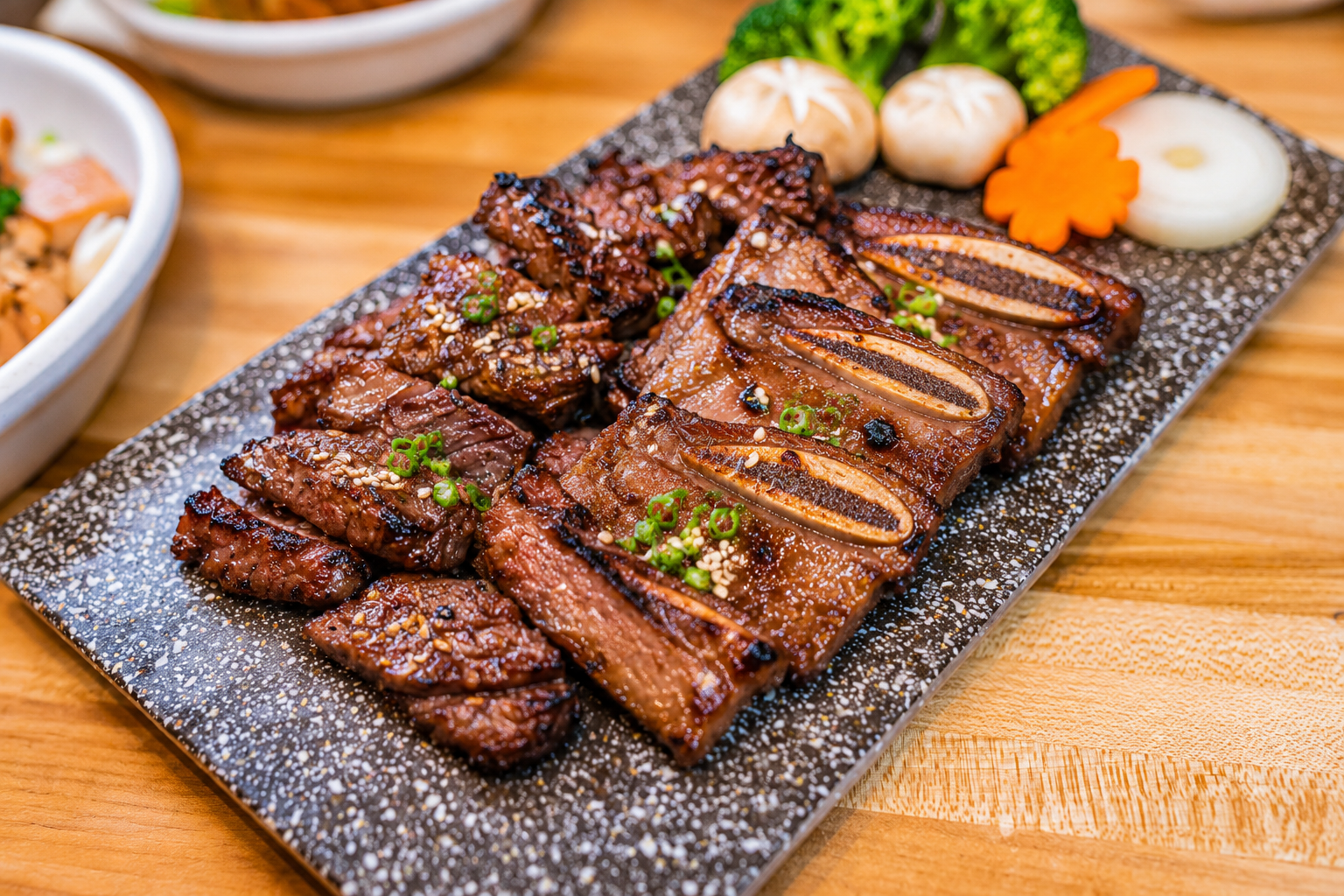
LA galbi is thin-cut Korean beef short ribs in a sweet soy marinade. They cook in minutes and come out glossy, caramelized, and tender, with no spice at all.
Most LA galbi recipes start with a homemade marinade of pear, onion, garlic, and soy sauce. I skip that step. I make LA galbi with store-bought marinade, a bottle of Korean galbi sauce plus a splash of extra soy sauce. Then I cook it in a skillet or under the oven broiler, so you don’t need a grill.
Quick answer:
- What it is: beef short ribs sliced thin across the bone, marinated, then cooked fast over high heat
- Spice level: 0 (out of 3)
- Must-haves: flanken-cut short ribs, one bottle of Korean galbi marinade, soy sauce
- Time: about 45 minutes of work, plus at least 4 hours in the fridge
What Is LA Galbi?
Galbi (갈비, “GAHL-bee”) means “ribs” in Korean. It’s also the name of a dish: beef short ribs in a sweet soy marinade, cooked over high heat.
LA galbi (LA 갈비, “el-ay GAHL-bee”) is one version, and the difference is the cut. The ribs are sliced thin across the bone, about ¼ inch (6 mm) thick. Each long strip has three or four small ovals of bone along one edge. Butchers in the U.S. call this a flanken cut.
Traditional galbi uses thicker meat on a single bone, often butterflied by hand. The thin cut is faster and easier, which makes it a home favorite.
Nobody agrees on where the name came from. One story says Korean immigrants in Los Angeles started using this American cut. Another says “LA” comes from “lateral,” the direction of the cut. Either way, the dish is now common in Korea too.
What Does LA Galbi Taste Like?
The first bite is sweet and salty, a bit like teriyaki but deeper and less sugary. Garlic, fruit, and sesame come through next. The edges get sticky and slightly charred, and many people fight over those bits.
Short ribs have a fair amount of fat, so the meat stays juicy. It’s tender but has some chew near the bone. Expect to nibble the little bones with your fingers.
Is LA Galbi Spicy?
No. On this blog’s 0 to 3 spice scale, classic LA galbi is a 0. Regular galbi marinades contain no chili, so it’s a safe pick for kids and spice-shy guests.
At a Korean table, the heat comes from the sides, such as kimchi or a chili paste dip. Serve those in small bowls and the meal can stay mild. For a kick, stir a pinch of gochugaru (Korean chili flakes) into the marinade.
To compare with other dishes, see our Korean Spice Guide.
How Koreans Eat LA Galbi
This is party food. Families make big batches for Lunar New Year (Seollal), the fall holiday Chuseok, birthdays, and cookouts. It’s also a classic order at Korean BBQ restaurants.
At the table, the long strips are cut between the bones with kitchen scissors. Everyone takes pieces with chopsticks and eats them with rice.
Many people also make lettuce wraps, called ssam (쌈). Put a piece of meat and a little rice on a lettuce leaf. Add a dab of ssamjang (쌈장, “SAHM-jahng”), a thick soybean and chili dip. Then fold it up and eat it in one bite. Kimchi and other small side dishes, called banchan (반찬), fill out the meal.

LA Galbi Ingredients and Where to Buy Them
You need only three ingredients. The meat is the one to shop for carefully.
- LA galbi (flanken-cut short ribs): Korean markets such as H Mart sell them labeled “LA galbi” or “LA style short ribs,” both plain and pre-marinated. At regular stores, check the meat counter for “flanken-cut” or “Korean-style” short ribs. I usually buy mine at Whole Foods, and sometimes at H Mart. My Whole Foods sometimes has ready-cut packs labeled LA galbi, but not always, so ask at the meat counter. Costco and other warehouse stores may carry big multi-pound packs.
- Korean galbi marinade: I use Chung Jung One Beef Galbi Marinade. Look for the brand name 청정원 on the label. Whole Foods sells galbi sauce too, so you may get everything in one trip. Korean markets carry many more brands, such as CJ Beksul. Pick one made for beef galbi, and skip the pork or spicy versions.
- Soy sauce: any regular soy sauce from the supermarket.
Check the thickness. The ribs should be about ⅛ to ¼ inch (3 to 6 mm) thick. Some flanken cuts are ½ inch (1.3 cm) or more. Those take longer to cook and can turn tough, so ask the butcher to slice them thinner.
Why I use a store-bought marinade
A homemade galbi marinade usually means grating pear and onion and measuring six or seven ingredients. A bottled marinade already has that balance of soy sauce, sugar, fruit, and garlic, so prep takes five minutes.
The catch: many bottled marinades taste sweeter than homemade. So I pour in some more soy sauce. It brings the salty side forward and keeps the sugar in check.
Keep in mind that this is a shortcut. A from-scratch marinade lets you control the sugar and fruit. With a bottle, the flavor depends on the brand, so taste it before the meat goes in.
| If you can’t find | Use | What changes |
|---|---|---|
| Flanken-cut ribs | Boneless short ribs or ribeye, sliced thin | No bones to nibble. Ribeye is more tender and cooks even faster. |
| Korean galbi marinade | Korean bulgogi marinade | Very close in flavor, often a bit lighter |
| Regular soy sauce | Low-sodium soy sauce | Less salty. Add a little more to taste. |
| Soy sauce (for gluten-free) | Tamari | Same job, but most galbi marinades contain wheat. Check for a gluten-free marinade. |
For more swaps, see our Korean Ingredient Substitutes Finder.

Easy LA Galbi Recipe With Store-Bought Marinade
This is my everyday version: one whole bottle of marinade, more soy sauce, and a skillet or the broiler. The soaking and marinating times follow common Korean home practice.

Easy LA Galbi With Store-Bought Marinade
Ingredients
Equipment
Method
- Rinse the ribs under cold running water. Rub the cut edges with your fingers to wash off small bone chips left from the saw.
- Put the ribs in a large bowl and cover them with cold water. Soak for 20 to 30 minutes, changing the water once when it turns pink and cloudy.
- Drain the ribs and pat them dry with paper towels.
- In a large bowl or zip-top bag, mix the marinade and soy sauce. Taste a drop before the raw meat goes in, and add more soy sauce if it’s too sweet. Stir in the onion, if using.
- Add the ribs and turn each piece so it’s fully coated. Seal or cover, and refrigerate for 4 hours or overnight. Don’t go past 24 hours.
- Take the ribs out about 15 minutes before cooking. Let the extra marinade drip off each piece.
- Skillet: heat a large skillet over medium-high heat with a little oil. Cook the ribs in one layer, 2 to 3 minutes per side, until the edges are dark brown and sticky and no red meat shows. Lower the heat if the sugar smokes. Wipe the pan between batches.
- Broiler: set a rack about 6 inches (15 cm) below the broiler and preheat on high. Lay the ribs flat on a foil-lined sheet pan. Broil 5 to 6 minutes, flip, and broil 3 to 4 minutes more, watching closely.
- Cut between the bones with clean kitchen scissors, sprinkle with green onions and sesame seeds, and serve hot with rice, lettuce, ssamjang, and kimchi.
Notes
- Spice level: 0 on the blog’s 0 to 3 scale. Add a pinch of gochugaru to the marinade for a little heat.
- Thick flanken cuts (½ inch or more) take longer and can turn tough. Ask the butcher to slice them ¼ inch thick or thinner.
- Food safety: marinate in the fridge only. Throw away marinade that touched raw beef, or boil it hard for a few minutes before using it as a sauce. The thickest part should reach 145°F (63°C).
- Freezing: freeze raw ribs in the marinade, flat in freezer bags, and use within about 3 months. Thaw overnight in the fridge.
- Allergens: soy, wheat, and often sesame (check your marinade label).
- Vegan option: use the same bottled marinade (fresh from the bottle) on king oyster mushroom planks or pressed extra-firm tofu. Check the label for beef extract, anchovy, or oyster sauce.
Thin ribs cook through quickly. If you use a thermometer, the thickest part should read 145°F (63°C) or higher.


Is LA Galbi Vegetarian or Vegan?
No, it’s a beef dish. But the same bottled marinade works on plant foods for a similar sweet soy flavor.
- King oyster mushrooms: slice them lengthwise into thin planks, marinate 30 minutes, and pan-fry until browned.
- Extra-firm tofu: press it, slice it into flat pieces, marinate 1 hour, and pan-fry until the edges caramelize.
- Read the label: most galbi marinades are soy sauce, sugar, fruit, and garlic, but some contain beef extract, anchovy, or oyster sauce. Check the full ingredient list.
Use marinade straight from the bottle for plant foods. Never use marinade that has touched raw beef.
If Your Ribs Burn, Turn Tough, or Taste Too Sweet
It’s burnt outside but not cooked inside. The heat was too high for the thickness. Lower the heat to medium, or move the pan one rack lower under the broiler.
It’s tough and chewy. The ribs were cooked too long, or they were cut too thick. Thin ribs need only a few minutes per side.
It tastes too sweet. Use more soy sauce next time. Lettuce, kimchi, and plain rice on the side also help.
It tastes too salty. The ribs marinated too long, or the brand is salty. Shorten the time, or skip the extra soy sauce.
The meat turned soft and mushy. It sat in the marinade too long. Keep it under 24 hours.
The smoke alarm went off. Dripping sugar burns on a hot pan. Let the extra marinade drip off before cooking, use foil under the broiler, and turn on the vent fan.
What to Serve With It
Start with a bowl of rice. Our Korean rice guide covers which rice to buy and how to cook it.
For a holiday spread, add japchae and Korean pancakes. For a weeknight, a pot of doenjang jjigae and a bowl of kimchi are enough.
Feeding a group? Our Korean BBQ Party Planner helps you figure out how much meat and how many sides to buy.

How to Store and Reheat LA Galbi
Refrigerate cooked ribs in an airtight container within 2 hours (1 hour if it’s above 90°F / 32°C). Eat it within 3 to 4 days.
To reheat, warm it in a skillet over medium heat for 1 to 2 minutes per side. The microwave works too, but cover the dish so the meat doesn’t dry out.
Raw ribs freeze well in the marinade. Pack them flat in freezer bags in meal-size portions, and use within about 3 months. Thaw them overnight in the fridge, never on the counter.
Leftover meat is good chopped up in bibimbap or fried rice.
Allergens: soy and wheat (in most galbi marinades and soy sauce), and often sesame. Check the label of your brand.
Safety: always marinate in the fridge. Never leave raw meat on the counter. Throw away leftover marinade that touched raw beef, or boil it hard for a few minutes before using it as a sauce. Use clean scissors and a clean board for the cooked ribs.
LA Galbi FAQ
What’s the difference between LA galbi and regular galbi?
The cut. LA galbi is sliced thin across several bones, so each strip has small bone pieces along one side. Regular galbi is a thicker piece of meat on one bone. The marinade can be the same.
Do I have to soak LA galbi in water?
No, but it’s a common Korean step. Many cooks feel it gives a cleaner taste. If you skip it, rinse the ribs well to remove bone chips.
How long should LA galbi marinate?
Four hours to overnight. With a store-bought marinade, even 30 minutes adds flavor if you’re short on time. Past 24 hours, the meat can turn soft.
Can I cook LA galbi in the oven?
Yes. Use the broiler, with the rack about 6 inches (15 cm) below the heat. It takes about 10 minutes and handles a big batch at once.
For your first batch, use the skillet. You can watch the ribs closely and see how fast the sugar browns. Then try the broiler for a crowd. LA galbi with store-bought marinade is a simple way to put a Korean holiday favorite on the table. For more beef cooked in a sweet soy sauce, try our bulgogi guide.

Leave a Reply